
Tavily
- Free plan: 1000 credits/mo, no card required
- Paid plans: from $30/mo, Pay As You Go - $0.008/credit
- API, Python SDK, TypeScript SDK, 18+ integrations
- SOC 2 Type II certification, zero data retention
- Founded in 2023, acquired by Nebius Group for $275M in 2026
Search API, optimized for LLM and AI agents
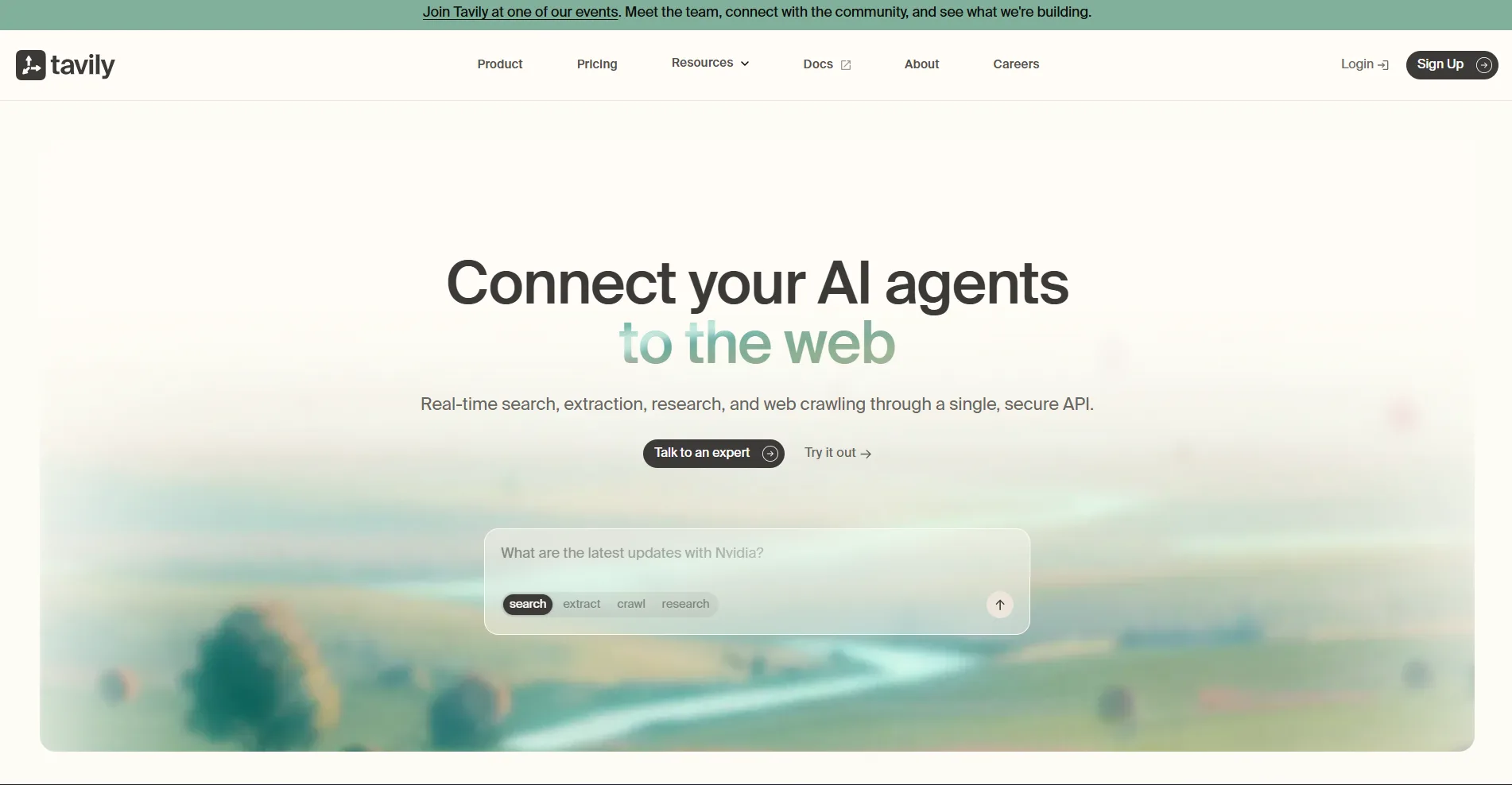
Tavily is a specialized search API developed not for humans, but for LLM agents. Unlike SerpAPI or Brave Search, the platform aggregates up to 20 sources per call, ranks them using its own AI algorithm, and returns clean snippets in JSON format-ready for direct injection into the model's context without additional parsing.
Key Features of Tavily
- Real-time Web Search API - aggregates up to 20 sources per call, returns title, URL, snippet, and relevance in a unified JSON. Basic search costs 1 credit, Advanced costs 2 credits.
- Extract API - extracts full structured content from specific URLs; only successful extractions are charged (1 credit per every 5 URLs).
- Map & Crawl API - the /map endpoint builds a map of a site's structure through internal links, while /crawl sequentially traverses pages. Used for indexing corporate knowledge bases.
- Research API (/research) - an “agent-in-a-box”: performs iterative searches, deliberates on data, deduplicates, and returns a ready analytical report. Used for due diligence and regulatory reviews.
- Domain Filtering & Search Depth - search can be limited to specific domains, unwanted sources excluded, and date ranges set. Critical for corporate agents relying on verified sources.
- AI Framework Integration - official packages for LangChain and LlamaIndex, MCP server support for Cursor and Claude Desktop, integrations with CrewAI, Vercel AI SDK, OpenAI, Anthropic, Snowflake, Azure MCP, and Databricks.
- Built-in Security - firewall blocks prompt injections and PII leaks; SOC 2 Type II certification; zero user data storage as a standard principle.
Advantages and Limitations
- JSON format ready for LLM without parsing
- Integration in 4 lines of code
- SOC 2 Type II + zero data retention
- Built-in source citation
- 1 million+ developers, Fortune 500 clients
- Native MCP support for Claude and Cursor
- No UI - only API for developers
- Credits do not roll over to next month
- /research API: accuracy ~39% vs 70%+ of Perplexity Sonar
- No multimodality (text only)
- Risk of focus shift after acquisition by Nebius
Tavily Pricing and Plans
Credit system: Basic Search = 1 credit, Advanced Search = 2 credits, Extract = 1 credit per every 5 URLs. Unused credits are forfeited at end of month.
- 1000 API credits per month
- No credit card required
- Search, Extract, Map, Crawl API
- Email support
- Billing after limit is exceeded
- No fixed fees
- Flexibility for variable workloads
- $25/mo on annual payment
- Increased credit limit
- Higher rate limits
- Email support
- $83/mo on annual payment
- ~15,000 searches per month
- Scalable solution for teams
- Increased rate limits
- Up to 100,000 credits per month
- Custom rate limits and volumes
- SLA and enterprise support
- Extended privacy
Tavily vs Competitors: Where it Wins and Loses
Closest competitor, Exa AI, uses neural indexing for semantic search and achieves a P50 latency under 350 ms (Exa 2.0, March 2026). For semantic query accuracy, Exa slightly outperforms Tavily (94.9% vs ~93%), but is more complex to set up and more expensive.
SerpAPI and Serper provide raw Google SERP data for $1-8 for 1K requests compared to $8 at Tavily but require self-parsing and formatting for LLM. For teams lacking web scraping infrastructure, the price difference is offset by the development effort for pipeline creation.
Perplexity Sonar API provides ready answers with citations and demonstrates 70%+ accuracy on research tasks-compared with ~39% of \/research endpoint at Tavily by May 2026 benchmarks. However, Perplexity's deep research can cost up to $5500 for 1K requests. Firecrawl specializes in deep content extraction and offers ~6.7x more usable credits for $100/mo compared to Startup plan but lacks a search-first approach.
Usage Scenarios
Who is Tavily For
- AI Developers and ML Engineers - build agents and RAG systems with real-time access to web data via LangChain or LlamaIndex in minutes.
- Product Startups - create AI assistants and research tools without developing their own web scraping infrastructure.
- Fortune 500 Enterprise AI Teams - financial services, logistics, corporate operations with SOC 2 and zero data retention requirements.
- AI Coding Tool Developers - JetBrains (agent Junie) uses the platform to verify API documentation relevance and prevent hallucinations.
How to Get Started with Tavily
-
1Sign up on tavily.com - the free Researcher plan activates without a credit card, 1000 credits available immediately.
-
2Get an API Key - in the Dashboard, copy the key and install the SDK:
pip install tavily-pythonfor Python ornpm install @tavily/corefor TypeScript. -
3Perform Your First Search - initialize the client with the API key and call
client.search(query). A JSON response with snippets, URLs, and relevance will arrive in milliseconds. -
4Connect to an Agent - add
TavilySearchResultsfrom langchain-tavily as a LangChain agent tool or configure an MCP server for Claude Desktop via the official documentation. -
5Choose a Plan - if you exceed 1000 credits/mo, switch to Pay As You Go ($0.008/credit) or the Startup plan ($100/mo, ~15,000 searches).
Frequently Asked Questions
How does Tavily differ from SerpAPI or a typical search API?
Traditional search APIs return raw HTML or SERP data, requiring self-parsing and formatting for LLM. Tavily immediately provides clean JSON snippets with URL, relevance, and source name-ready for direct injection into a language model context.
How does the credit system work and do credits expire?
Basic Search costs 1 credit, Advanced Search 2 credits, Extract 1 credit per every 5 URLs. Credits do not carry over; unused credits expire at the end of the billing month.
What changed after Tavily was acquired by Nebius Group?
In February 2026, Nebius Group (NASDAQ: NBIS) acquired the platform for $275 million in cash with potential payouts up to $400 million. Brand, API, and team led by CEO Rotem Weiss were retained; the main novelty is integration into the Nvidia AI-Q Blueprint as a native search layer.
How to connect Tavily to Claude via MCP?
Tavily supports MCP servers natively-add server configuration in the Claude Desktop or Cursor settings according to the official MCP documentation. After this, Claude will be able to call the search API automatically when current information is needed.
Tavily has become the de facto search layer standard for LLM agents: from startup to 1 million developers, clients like IBM and Groq, and a deal with Nebius worth $275 million in just three years. For teams building production RAG systems or autonomous agents, it's the fastest route to verified, citable web data without infrastructure costs.